
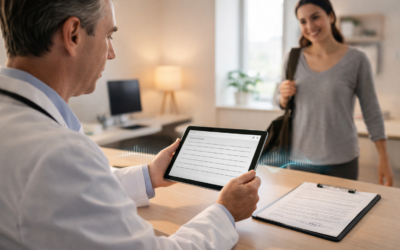
The Shift From After-Hours Charting to In-Encounter Documentation
There was a time when after-hours charting was accepted as simply part of being a physician. You saw patients during the day and you documented their encounters in the evening. That arrangement was never ideal, but it was manageable when patient volumes were lower and documentation requirements were less demanding. Today, the combination of high patient volumes, complex regulatory requirements, and the persistent pressure to improve productivity has made evening charting a genuine quality-of-life crisis for many clinicians. Real-time medical dictation software shifts documentation back into the clinical encounter itself, or the minutes immediately following it, where it belongs.
The Technology Infrastructure Behind Real-Time Performance
Achieving genuinely real-time performance in clinical dictation requires substantial technical infrastructure. Audio must be captured cleanly in sometimes noisy clinical environments. Processing must happen quickly enough to provide near-instantaneous text output. The AI models doing the conversion must handle medical terminology, physician accents, and clinical context with high reliability.
Modern real-time medical dictation software platforms have invested heavily in each of these technical dimensions. Edge computing capabilities allow some processing to happen on the device itself, reducing latency. Noise cancellation algorithms handle the ambient sounds of clinical environments. And continuously improving AI models drive accuracy rates that are now competitive with human transcriptionists in many specialty contexts.
The Workflow Integration Challenge
Real-time performance only delivers its potential value if the technology integrates smoothly into the clinical workflow. A physician who must open a separate application, navigate to a recording mode, wait for the system to initialize, and then trigger capture manually will quickly find the friction outweighs the benefit.
The best real-time platforms are designed around minimal physician friction. Some activate automatically when the physician enters the exam room, using location or login triggers to begin capture. Others offer ambient listening modes that require no manual initiation at all. The less the physician has to think about the technology, the more benefit the technology delivers.
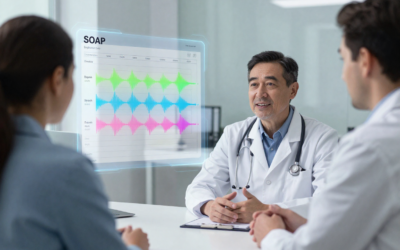
Future Directions: From Dictation to Clinical Intelligence
The next evolution of real-time dictation goes beyond capturing spoken words and moves toward understanding clinical context. Systems that not only hear what a physician says during an encounter but also recognize that a medication being discussed has a potential interaction with an existing prescription, or that the described symptoms warrant a specific follow-up recommendation, represent the next frontier.
This convergence of dictation and clinical decision support is already in early development at several companies. When it matures, real-time capture will be not just a documentation tool but an active participant in the clinical reasoning process.
Conclusion
For physicians committed to sustainable, high-quality clinical practice, real-time medical dictation software is not a luxury. It is a foundational tool that aligns documentation with the natural rhythm of clinical care. The practices that adopt it today are building workflows that will support them as documentation demands continue to grow.
